A fact file
96 official facts about Roman Britain
Each line is taken from an official English Heritage page. The official nuances, gathered in one place, also live on the field notes.
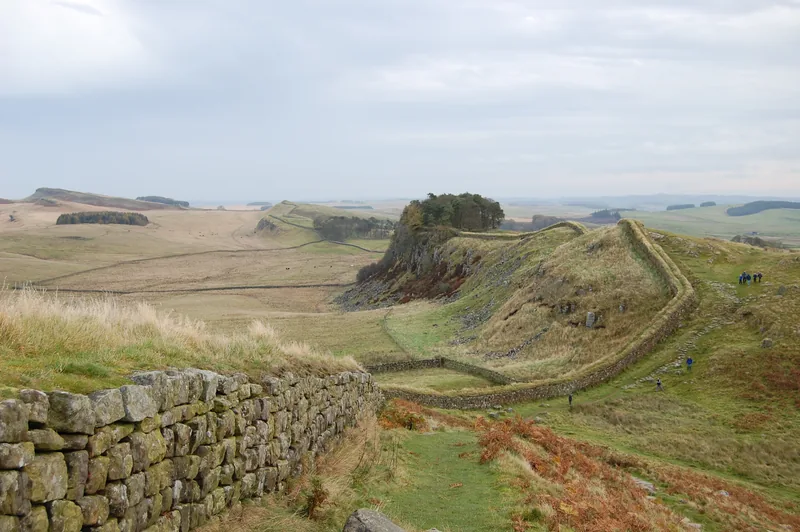
- Roman administration in Britain lasted about 370 years. [source]
- English Heritage compares that span with “the same length of time as now to the end of the English Civil Wars in 1651.” [source]
- The period “spanned more than 80 emperors.” [source]
- Julius Caesar’s expedition of 55 BC is called “a reconnaissance.” [source]
- The expedition of 54 BC is called “a serious attack.” [source]
- After those expeditions, “the Romans did not stay.” [source]
- Verica was expelled in AD 42, a “pretext for Claudius.” [source]
- Claudius sent an army to Britain in AD 43. [source]
- The army “probably landed at Richborough in Kent.” [source]
- The impressive stone walls at Richborough “belong to a later, 3rd-century fort.” [source]
- “The coastline was much closer than it is today.” [source]
- By AD 47 the army had “a firm grip” on the South and East. [source]
- The frontier of that date ran from Exeter to the Humber. [source]
- In AD 60, Boudica, “the queen of the Iceni tribe, led a revolt.” [source]
- The revolt destroyed Camulodunum (Colchester). [source]
- It also destroyed Verulamium (St Albans). [source]
- And Londinium (London). [source]
- The victory “was short-lived.” [source]
- Advance resumed around AD 70. [source]
- Agricola reached “as far as Aberdeen.” [source]
- Mons Graupius is dated AD 83. [source]
- Troops were later withdrawn “to deal with trouble on the Danube frontier.” [source]
- By around AD 105 a new border lay along the Stanegate, from the Tyne to the Solway Firth. [source]
- There were permanent bases for three legions of 4,800 men at Caerleon, Chester and York. [source]
- Those legionaries were “formed of Roman citizens.” [source]
- Auxiliary troops were “raised from non-citizens in the provinces.” [source]
- Hadrian visited Britain in AD 122. [source]
- He “ordered the building of a wall to stretch from sea to sea.” [source]
- Hadrian’s Wall “was mostly complete by AD 130.” [source]
- From around AD 142 Antoninus Pius built the Antonine Wall on the Forth–Clyde isthmus. [source]
- The Antonine Wall was “gradually abandoned between AD 158 and AD 164.” [source]
- Septimius Severus campaigned in the far north in AD 208–11. [source]
- “Territory was not permanently conquered.” [source]
- “Hadrian’s Wall remained the effective imperial frontier.” [source]
- There was an early 4th-century “villa flourish.” [source]
- Towns were “not what they had been in the 2nd century.” [source]
- Grain was exported, and troops were withdrawn in the AD 350s. [source]
- Trouble came from around AD 360, including the Great Conspiracy of AD 367. [source]
- Valentinian (r. AD 364–75) “strengthened garrisons.” [source]
- “Confident new building ceased by the AD 370s.” [source]
- Magnus Maximus is dated AD 383–8. [source]
- Constantine III is dated AD 407–11. [source]
- By AD 411 Britain was “formally separated,” and “town life collapsed.” [source]
- “Camulodunum was initially the province’s main town, though Londinium quickly replaced it.” [source]
- “There was never a massive influx of ‘Romans’.” [source]
- The people of Britannia “were mostly the descendants of the pre-Roman tribes.” [source]
- The population “was probably between 3 and 4 million.” [source]
- The army comprised “up to 50,000.” [source]
- Civitates were “based on the tribal territories,” with capitals at Silchester, St Albans, Aldborough and Wroxeter. [source]
- Between around AD 70 and the later 2nd century, “such towns generally grew and prospered.” [source]
- Hadrian “was born in Rome in AD 76.” [source]
- He “became emperor in AD 117, succeeding Trajan.” [source]
- A biographer, in English Heritage’s wording, said he ordered the army to “build a wall, 80 miles long, to separate the Romans from the barbarians.” [source]
- The wall is “73 miles (or 80 Roman miles)” long. [source]
- It runs from Bowness-on-Solway to Wallsend. [source]
- It took “at least six years to build.” [source]
- In 2022 English Heritage celebrated 1,900 years of the wall. [source]
- The tallest remaining parts stand “about 15 feet (4.6 m).” [source]
- It was planned “10 Roman feet (3 m) wide.” [source]
- It was built “8 Roman feet (2.4 m) or less.” [source]
- There is “no technical start or end.” [source]
- Fortifications “continued around 25 miles down the Solway coast,” and “were not part of the wall.” [source]
- It was built almost entirely by the Second Legion (Caerleon), the Sixth (York) and the Twentieth (Chester). [source]
- The wall became a UNESCO World Heritage Site in 1987. [source]
- It is a “complex of wall, earthwork, ditch, roads, forts, milecastles, turrets.” [source]
- English Heritage cares for Birdoswald, Housesteads (owned by the National Trust but managed by English Heritage) and Chesters, as well as Corbridge Roman Town and around twenty sections of the wall. [source]
- “Londinium (London), Aqua Sulis (Bath) and Lindum Colonia (Lincoln)” still exist as modern towns. [source]
- “Coria (Corbridge) and Isurium Brigantium (Aldborough) are Roman towns you can visit today.” [source]
- Aqua Sulis is the spelling on the ingenuity page. [source]
- Most Iron Age buildings in Britain “were made of timber and were often round in form.” [source]
- “The Romans built in stone, in straight lines and in a grand scale.” [source]
- The latrines at Housesteads “are some of the best preserved Roman toilets in the country.” [source]
- They were flushed “by a channel running anti-clockwise,” using “rainwater and draining surface water.” [source]
- “You can sometimes see how this worked on a rainy day.” [source]
- Until the mid-1960s, “no-one had found any pieces” of lorica segmentata to study. [source]
- The Corbridge Hoard was discovered in 1964, in “an iron-bound, leather-covered chest.” [source]
- The armour “could be stored very compactly.” [source]
- A Samian bowl from South Gaul, “c. AD 70 - 85 AD,” is stamped “OF CEN,” possibly for Censorinus. [source]
- Watling Street still underlies “the A2 and the A5.” [source]
- Dere Street still underlies “the A59 and A1 from York.” [source]
- A Roman mile, the mille passum, was a thousand paces of five Roman feet, “meaning a Roman mile measured 5,000 feet.” [source]
- “Hadrian’s Wall is 80 Roman miles long, and each mile was marked by a milecastle fort.” [source]
- “Before the Romans arrived, coinage wasn’t in use in northern Britain — although parts of Southern Britain did have coins.” [source]
- “A denarius minted in Rome could be spent in Britain, North Africa or Turkey.” [source]
- English Heritage adds, “such a global currency has not been seen since.” [source]
- A counterfeit with a copper core and a silver plate “came from the settlement outside of the fort at Housesteads.” [source]
- Corbridge lies “2½ miles south of Hadrian’s Wall.” [source]
- The visible town there “developed after AD 160 around a base for legionary soldiers.” [source]
- That replaced forts “built from about AD 85 where one of the main routes northwards crossed the River Tyne.” [source]
- It became “one of only two substantial towns in the Hadrian’s Wall zone.” [source]
- Aldborough “was once the prosperous Roman town of Isurium Brigantum.” [source]
- It “began as a trading settlement around AD 70.” [source]
- It was civilian capital “from about AD 120 to about AD 400.” [source]
- “Brigantes, meaning ‘the hill people’, was a term given by the Romans to the people who occupied most of northern England.” [source]
- A planned town began at Aldborough “in around AD 120,” with a street grid, forum and basilica. [source]
- The town was “fortified with a stone wall in the late 2nd century.” [source]
Keep exploring
- Myths versus facts — Caesar did not stay, and the Colosseum is not in Britain.
- Field notes — 73 miles and 80 Roman miles, kept in the official sentence.
Enjoyed this Roman desk?
No pop-ups. No intrusive advertising. Just interesting stuff. A little support helps the next ages.im site get built.