Myths versus facts
Caesar did not stay, and the Colosseum is not in Britain
Twelve claims people often bring to Roman Britain, set beside the official English Heritage wording.
The claim
Julius Caesar conquered Britain and the Romans stayed.
What the official page says
English Heritage calls 55 BC “a reconnaissance” and 54 BC “a serious attack,” and says “the Romans did not stay.” The army that stayed was sent by Claudius in AD 43. [source]
The claim
Hadrian’s Wall is 80 modern miles long.
What the official page says
The official FAQ gives the length as “73 miles (or 80 Roman miles).” Both figures sit in the same official sentence, and are not rewritten as each other. [source]
The claim
Hadrian’s Wall marks the border with Scotland.
What the official page says
The wall runs from Bowness-on-Solway to Wallsend. The later Antonine Wall, not Hadrian’s, was built “on the Forth–Clyde isthmus,” and was abandoned between AD 158 and AD 164. Hadrian’s Wall “remained the effective imperial frontier.” [source] [source]
The claim
The stone walls at Richborough are the landing place of AD 43, unchanged.
What the official page says
The army “probably landed at Richborough,” but the impressive stone walls “belong to a later, 3rd-century fort,” and “the coastline was much closer than it is today.” [source]
The claim
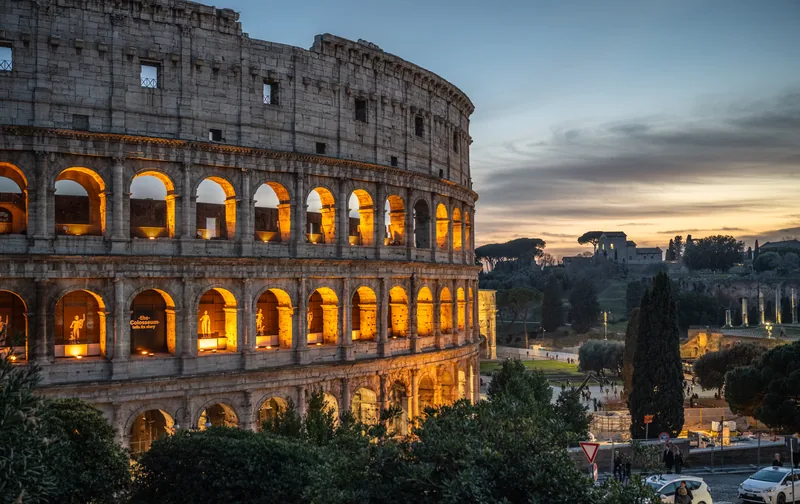
The Colosseum stands in Roman Britain.
What the official page says
It does not. The photograph on this site is of the Colosseum in Rome, included as a picture of the empire’s capital, not as a British monument.
The claim
Roman Britain was filled by a massive influx of people from Rome.
What the official page says
English Heritage says “there was never a massive influx of ‘Romans’.” The people “were mostly the descendants of the pre-Roman tribes,” with “a veneer of Roman officials.” [source]
The claim
The Antonine Wall permanently replaced Hadrian’s Wall.
What the official page says
It “only had a short life, being gradually abandoned between AD 158 and AD 164.” After Severus’s campaign, “Hadrian’s Wall remained the effective imperial frontier.” [source]
The claim
The wall is only a wall.
What the official page says
The official FAQ calls it a “complex of wall, earthwork, ditch, roads, forts, milecastles, turrets.” Coastal fortifications ran “around 25 miles down the Solway coast,” and “were not part of the wall.” [source]
The claim
Toilets and clean water arrived in Britain in modern times.
What the official page says
English Heritage says clean water and sanitation were “a new concept to Britain when the Romans arrived.” The latrines at Housesteads “are some of the best preserved Roman toilets in the country.” [source]
The claim
Northern Britain already used coins in the same way as the south.
What the official page says
“Before the Romans arrived, coinage wasn’t in use in northern Britain — although parts of Southern Britain did have coins.” [source]
The claim
Lorica segmentata was always well understood from surviving suits.
What the official page says
Until the mid-1960s “archaeologists only had descriptions and pictures to go on. No-one had found any pieces to study.” The Corbridge Hoard of 1964 changed that. [source]
The claim
Aqua Sulis is a modern nickname, not an official pairing.
What the official page says
English Heritage’s ingenuity page writes “Aqua Sulis (Bath).” That official spelling is the one used in this site’s table. [source]
Keep exploring
- The fact file — the official sentences in a straight list.
- Field notes — where two official figures sit side by side.
Enjoyed this Roman desk?
No pop-ups. No intrusive advertising. Just interesting stuff. A little support helps the next ages.im site get built.